Interstellar Comet 3I/ATLAS Passes Closest to Earth
Early Friday morning on December 19, 2025, something rare slid past our planet. Interstellar Comet 3I/ATLAS reached its closest point to Earth and kept going. No alarms. No danger. Just a quiet flyby from deep space. At its nearest, the comet was about 168 million miles away. That is nearly twice the distance between Earth and the Sun. It sounds close in space terms, but this was still very far.
Even so, astronomers around the world were ready and watching.
Remember, this was not a comet born here. 3I/ATLAS came from another star system. It crossed into our solar system at high speed, curved around the Sun, and is now heading back out for good. Once it is gone, it will never return. The moment mattered because objects like this do not come often.
In fact, this was only the third confirmed interstellar visitor ever seen passing through our neighborhood.
Why This Flyby Was a Big Deal?
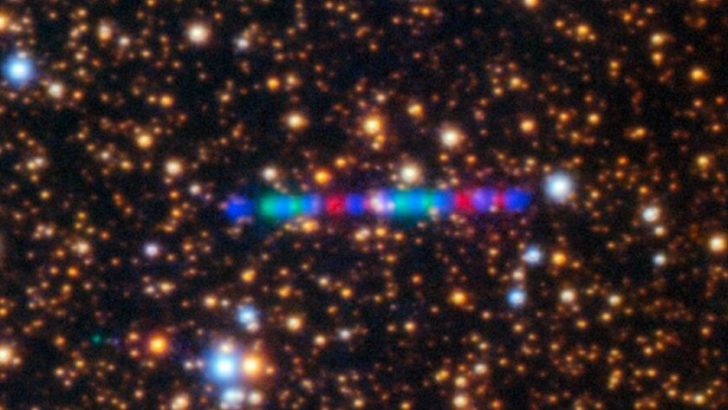
GTN / The “3I” label tells the story. It means the third interstellar object. Before this, scientists had only confirmed two, 1I/‘Oumuamua in 2017 and 2I/Borisov in 2019.
Each one changed how we understand space beyond our solar system.
Comet 3I/ATLAS was discovered on July 1, 2025, by the NASA-funded Asteroid Terrestrial-impact Last Alert System telescope in Chile. The system scans the sky every night, hunting for fast-moving objects. This one stood out right away.
Its path gave it away. The comet follows a hyperbolic orbit, meaning it is moving too fast to stay bound to the Sun. Gravity cannot trap it. It came from interstellar space, and it is heading straight back out.
Before reaching Earth, it passed closest to the Sun on October 30, 2025. That distance was about 130 million miles. Solar heat lit it up, releasing gas and dust and forming a classic comet coma. That activity helped confirm its natural origin.
Now the comet is fading as it travels outward. Telescopes will track it for months, but each week it grows dimmer and harder to study.
Could Anyone Actually See It?
For most people, the answer is no. The comet was never bright enough to see with your eyes alone. Even under perfect dark skies, it appeared only as a faint smudge through powerful gear. Observers with telescopes eight inches wide or larger had the best chance. Even then, it looked like a soft patch of light, not a dramatic tail.
The public experience came through screens. The Virtual Telescope Project hosted a free livestream of the event. The broadcast began late on December 18 and ran through the closest approach.
Thousands tuned in to watch a visitor from another star drift across the frame. It was quiet. It was subtle and historic.
A Cosmic Time Capsule From Another System
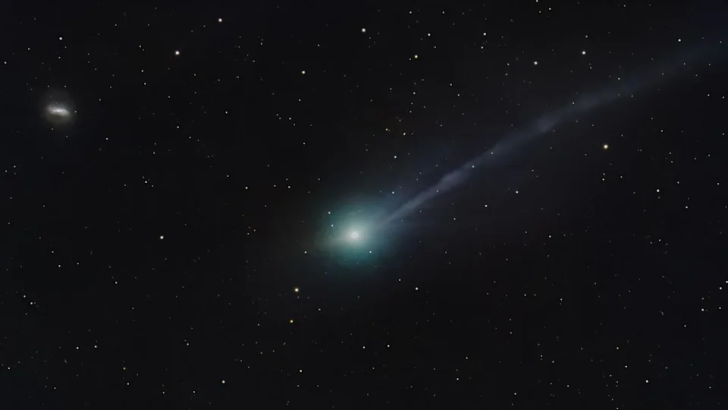
E Online / Interstellar objects carry stories our own solar system cannot tell. They formed around other stars, under different conditions, using different raw materials.
Comet 3I/ATLAS has a solid icy core. Estimates put its size somewhere between 1,000 feet and 3.5 miles wide. That range is large, but even the smallest estimate makes it a substantial object. Its chemistry suggests it formed far from its parent star, in a deep, cold region packed with ices. That environment may not match anything we see here. Some scientists believe it could be extremely old, possibly older than our Sun itself.
Age estimates range from three to fourteen billion years. If true, parts of this comet may predate Earth by billions of years. That idea alone makes it remarkable.